


CS Kit for Caesarean Surgery: What Hospitals Should Look For
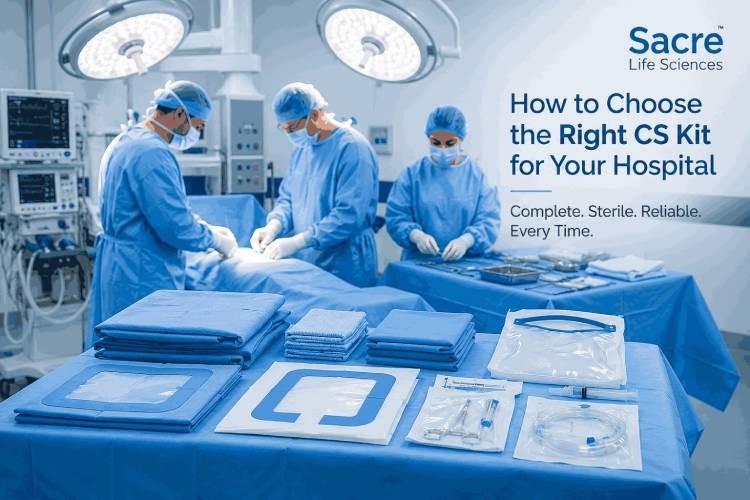
Caesarean sections are among the most frequently performed surgeries in any hospital's OT schedule. With that volume comes pressure — on staff time, on sterile supply budgets, and on maintaining consistent infection control across every single procedure. That's exactly the problem a well-designed CS kit is built to solve.
A CS kit (Caesarean Section kit) bundles every disposable drape and cover a surgical team needs for a C-section into a single pre-packed, pre-sterilized set. Instead of assembling drapes, gowns, and covers piece by piece before each delivery, the OT team opens one kit and everything required is already inside, already sterile, and already in the right sequence. For a procedure performed as often as a C-section, that difference adds up fast — in time saved, in reduced contamination risk, and in more predictable supply costs.
If your hospital or clinic is evaluating suppliers, here's what actually matters when you're comparing one CS kit against another.
1. What Should Actually Be Inside the Kit
Not all CS kits are assembled the same way, and a thin kit that's missing a component means someone on the surgical team has to break sterile field discipline to fetch it separately — which defeats the purpose entirely. A properly configured CS kit should include:
- A fenestrated caesarean drape sized for the lower abdomen
- Adhesive incise drape or fenestration reinforced around the surgical opening
- Under-buttock drape / bilateral leg covers where needed
- Mayo stand cover and instrument table cover
- Gown sets for the surgical team
- A fluid collection pouch, given how much blood loss management matters in obstetric surgery
- Absorbent layers positioned to manage amniotic fluid and blood without strike-through
Before you finalize a supplier, ask for a full component list — not just a photo of the outer packaging.
2. Material and Fluid Barrier Performance
C-sections involve significant fluid exposure, so the drape material can't just be "waterproof" in name only. Look for:
- SMS or SMMS non-woven fabric (spunbond-meltblown-spunbond), which balances strength with fluid resistance
- Reinforced zones around the fenestration and lower body where fluid contact is highest
- AAMI Level 3 or Level 4 barrier performance, appropriate for procedures with moderate-to-high fluid exposure
- Consistent basis weight (GSM) so the drape doesn't tear mid-procedure
A supplier who can share test data or compliance certificates for barrier performance is a good sign they're manufacturing to a standard, not just a price point.
3. Sterilization and Shelf Life
Every CS kit should be terminally sterilized — typically via Ethylene Oxide (ETO) — with a clearly printed sterilization date, expiry date, and lot number on each pack. For a busy maternity ward, shelf life matters just as much as sterility itself: kits that expire quickly create wastage, while a longer validated shelf life gives your central sterile supply department more flexibility in stock rotation.
Ask any prospective manufacturer for:
- Sterility assurance documentation
- Validated shelf-life duration
- Batch traceability in case of a recall
4. Consistency Across Batches
One of the most overlooked factors in kit selection is batch-to-batch consistency. If drape dimensions, fenestration placement, or packaging order changes between deliveries, OT staff lose the muscle memory that speeds up setup. A manufacturer with tight quality control — ISO 13485 certification is the marker to look for — is far more likely to deliver the same kit, every time, regardless of order size.
5. Regulatory Compliance and Documentation
Because a CS kit is a Class I/II medical device assembly in most jurisdictions, hospital procurement teams should confirm:
- ISO 13485 (Quality Management for Medical Devices) certification
- CE marking (for kits intended for markets that require it)
- Compliance with applicable national medical device regulations (e.g. India's CDSCO where relevant)
This isn't paperwork for its own sake — it's the difference between a supplier who treats sterile drapes as a commodity and one who treats them as a medical device with real risk if it fails.
6. Cost Per Procedure, Not Just Cost Per Kit
A cheaper kit that's missing components, has a shorter shelf life, or leads to even a single instance of strike-through and re-draping ends up costing more than a slightly higher-priced, properly engineered kit. When comparing quotes, calculate cost per successful procedure — factoring in wastage, staff time, and reorder frequency — rather than comparing sticker price alone.
Why This Matters for High-Volume Maternity Units
For hospitals and maternity centers running a high volume of caesarean deliveries, the CS kit isn't a minor line item — it's part of the infrastructure that keeps OT turnover fast and infection rates low. A kit that's well-designed lets the surgical team move from patient in to patient out with fewer interruptions, fewer improvised substitutions, and a more predictable sterile field every single time.
Sacre Life Sciences manufactures pre-sterilized CS kits designed around exactly these requirements — reinforced fluid barriers, complete component sets, ISO-certified manufacturing, and consistent batch quality for hospitals that can't afford variability in their maternity OT. View the full CS Kit specifications here →
Have questions about customizing a CS kit for your hospital's specific protocol? Get in touch with our team for samples and bulk pricing.